
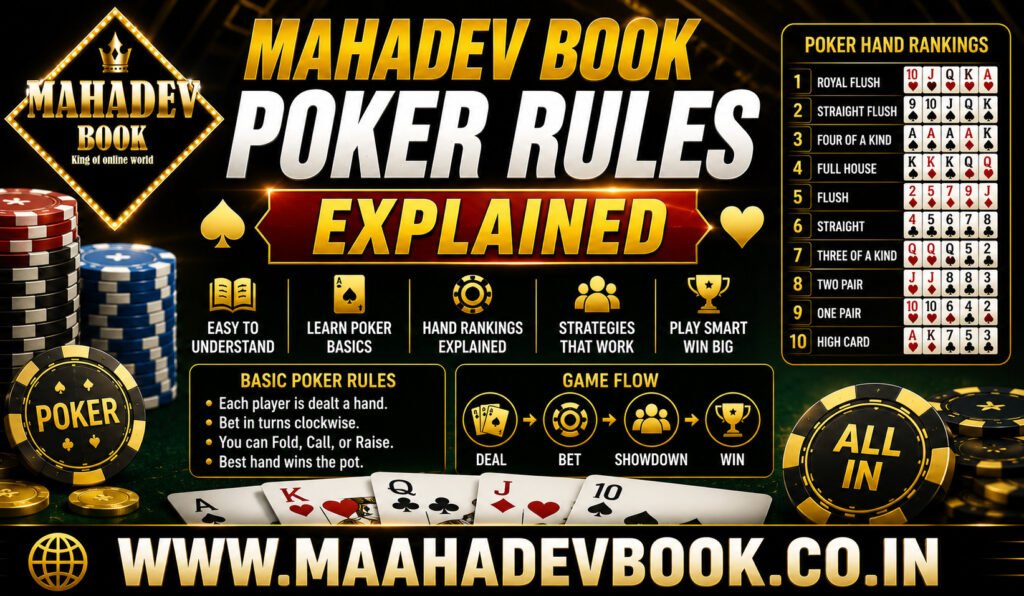
Poker is one of the most exciting card games available on Mahadev Book. Unlike many traditional casino games, poker combines skill, strategy, patience, and decision-making, creating an experience that keeps players engaged for hours. Every hand presents a new challenge, and every decision can influence the outcome of the game. This is one of the main reasons why poker continues to attract both beginners and experienced players on the platform.
Many users join Mahadev Book App for sports betting and online casino entertainment, but poker has developed a strong following because of its strategic nature. Players are not simply relying on luck; they are constantly evaluating their cards, studying betting patterns, and making decisions based on the information available at the table. This combination of skill and excitement makes poker one of the most rewarding card games to learn.
Whether you have recently created a Mahadev Book ID or have been using the platform for some time, understanding poker rules is essential before joining a table. Learning how poker works can help you make better decisions, understand betting situations, and enjoy the game with greater confidence. In this guide, we explain the rules of poker, hand rankings, betting rounds, Texas Hold’em gameplay, and the important concepts every player should understand before getting started.
Why Poker Is Popular on Mahadev Book
Poker has earned a special place among card game enthusiasts because no two hands are exactly the same. Every game creates different situations, forcing players to think carefully before acting. While some casino games provide instant results, poker rewards players who are patient and willing to develop their skills over time.
On Mahadev Book ID, poker attracts players because it offers a competitive experience where strategy plays a major role. Instead of playing against the system, players compete against each other. This creates an environment where observation, planning, and decision-making become valuable tools.
The convenience of accessing poker through a single account also contributes to its popularity. Users can move from sports betting to poker tables without switching platforms, making the overall experience smooth and enjoyable. The game is available across multiple devices, allowing players to participate whether they are using a desktop browser or a mobile device.
Understanding the Main Objective of Poker
The objective of poker is simple: win the pot.
The pot contains all the bets placed by players during a hand. Every decision made during the game is ultimately focused on winning that pot.
There are two ways to achieve this goal. The first is by holding the strongest hand when all remaining players reveal their cards at the showdown. The second is by making opponents fold before the final stage of the hand.
This second method is one of the reasons poker is considered such a strategic game. A player does not always need the strongest cards to win. Sometimes the ability to apply pressure and make opponents uncomfortable can be just as effective.
Understanding Poker Hand Rankings
Before participating in any poker game on Mahadev Book, players should understand hand rankings. These rankings determine which hand wins when multiple players reach the showdown.
Royal Flush
The Royal Flush is the strongest hand in poker. It consists of an Ace, King, Queen, Jack, and Ten of the same suit. This hand is extremely rare and unbeatable.
Straight Flush
A Straight Flush consists of five consecutive cards from the same suit. The higher the sequence, the stronger the hand.
Four of a Kind
This hand contains four cards of identical value. For example, four Kings or four Aces.
Full House
A Full House combines three cards of one rank with two cards of another rank.
Flush
A Flush consists of five cards from the same suit. The cards do not need to be consecutive.
Straight
Five consecutive cards form a Straight, regardless of suit.
Three of a Kind
Three cards of the same value create a Three of a Kind.
Two Pair
Two separate pairs within the same hand.
One Pair
Two cards of matching value.
High Card
If no player forms any combination, the highest individual card determines the winner.
Understanding these rankings is essential because every betting decision depends on evaluating the strength of your hand compared to potential hands held by opponents.
How a Typical Poker Hand Works on Mahadev Book
A poker game follows a sequence of stages that gradually build excitement and strategic complexity.
The hand begins with players receiving their starting cards. These cards form the foundation of their potential hand and influence their initial decisions.
Once the cards are dealt, the first betting round begins. Players evaluate their cards and decide whether to continue. Some may fold immediately if their starting hand is weak, while others may choose to call or raise.
As the game progresses, additional cards become available depending on the poker variation being played. These cards create new possibilities and often change the strength of existing hands.
Each stage is followed by another betting round, giving players opportunities to reassess their situation. The hand continues until either all opponents fold or the remaining players reach the showdown, where cards are revealed and compared.
Texas Hold’em Rules Explained
Texas Hold’em is the most popular poker format available today and is often the first variation new players encounter.
Each player begins with two private cards known as hole cards. These cards are visible only to the player who receives them.
The game then progresses through four major stages.
The first stage is known as the Flop, where three community cards are placed face-up on the table. These cards can be used by every player.
The second stage is called the Turn. A fourth community card is revealed, creating additional possibilities for strong hands.
The third stage is the River, where the fifth and final community card appears.
At the end of the final betting round, players combine their private cards with the community cards to create the strongest possible five-card hand.
Texas Hold’em is popular because the rules are relatively simple, yet the strategic possibilities are almost endless.
The Importance of Position at the Poker Table
Many beginners focus entirely on their cards and ignore position. However, experienced players understand that position is one of the most important factors in poker.
Position refers to where a player sits relative to the dealer button and determines when they must act during betting rounds.
Players who act later gain valuable information because they can observe how opponents behave before making decisions. This information often provides a significant strategic advantage.
Being in a late position allows players to make more informed decisions, control the size of the pot, and apply pressure more effectively when opportunities arise.
Reading the Community Cards
Community cards provide important information that should never be ignored.
As each card appears on the board, players should consider how it affects their hand as well as the possible hands of their opponents.
For example, if three cards of the same suit appear, there is a possibility that someone may have a Flush. If several consecutive cards appear, Straight combinations become more likely.
Successful poker players constantly evaluate these possibilities throughout every hand.
Building Better Starting Hand Selection
One of the most important skills in poker is knowing which hands to play.
Many beginners become excited and enter too many pots. While this approach creates more action, it often leads to difficult situations and unnecessary losses.
Strong starting hands provide better opportunities for success. Premium pairs, high-value face cards, and coordinated cards generally perform better than random combinations.
Learning patience and waiting for stronger opportunities is one of the most effective ways to improve overall poker performance.
Poker as a Game of Skill and Strategy
One reason poker remains so popular on Mahadev Book is that players can continuously improve. The more experience players gain, the more they begin to understand advanced concepts such as probability, risk management, opponent behavior, and strategic betting.
Unlike games where results are determined almost entirely by chance, poker allows players to learn from previous sessions and refine their approach over time.
Many experienced players spend years studying different aspects of poker, continually searching for ways to make better decisions and improve their understanding of the game.
Poker is much more than a simple card game. It is a strategic contest that combines skill, patience, observation, and decision-making. Whether you are exploring poker for the first time or looking to strengthen your understanding of the game, learning the rules is the foundation of success.
Mahadevbook provides users with access to exciting poker action through a convenient and accessible platform. By understanding hand rankings, betting rounds, Texas Hold’em rules, table position, and community card analysis, players can approach the game with greater confidence and make more informed decisions.
The more time you invest in learning poker fundamentals, the more enjoyable and rewarding the experience becomes. For anyone interested in card games that reward skill and strategic thinking, poker remains one of the best options available on Mahadev Book.
FAQs
What is poker on Mahadev Book?
Poker is a strategic card game available on Mahadev Book where players compete against each other to build the strongest hand or win through strategic betting.
What is the most popular poker variation?
Texas Hold’em is the most widely played poker variation and is popular among both beginners and experienced players.
Why is poker considered a skill-based game?
Poker involves decision-making, probability, strategy, and observation, allowing skilled players to improve their performance over time.
What is the strongest hand in poker?
A Royal Flush is the highest-ranking hand in poker.
Why is position important in poker?
Position gives players valuable information about opponents’ actions and can significantly influence strategic decisions during a hand.